Introduction
In a precast concrete production facility, reinforcing steel fabrication has a direct impact on production rates, product quality and overall workflow efficiency. As production volumes increase, project requirements become more varied and each reinforcing mesh must be tailored to a specific precast element, manual fabrication methods or reworking standard welded mesh panels can quickly become a bottleneck.
The objective is not simply to produce faster. For precast concrete manufacturers, the challenge is to manufacture the right welded mesh, in the right dimensions, at the right time, while reducing rework, minimising material waste and maintaining better control over production schedules.
In this context, automated production of custom welded mesh can become a strategic investment for manufacturers looking to streamline their production facilities, reduce manual operations and integrate reinforcing steel fabrication more efficiently into their precast concrete production process.
As the exclusive French representative of Schnell, the leading manufacturer of reinforcing steel processing technologies, since 1995, 3R Industries helps French manufacturers select solutions tailored to their production workflows, output requirements and workshop constraints.
Why do standard welded mesh panels quickly reach their limits?
Standard welded mesh panels are suitable for certain applications, but they do not always meet the requirements of industrial precast concrete production. Precast concrete elements often require specific dimensions, different wire diameters, local reinforcement zones or mesh configurations designed for a particular component.
When production starts from standard welded mesh panels that must then be cut, modified or bent manually, several challenges may arise:
- significant rework time ;
- accumulation of material offcuts ;
- additional handling operations ;
- risk of cutting or positioning errors ;
- reliance on experienced operators ;
- more complex traceability ;
- less predictable internal lead times.
Above a certain production volume, these adjustments are no longer simple finishing operations: they become a production bottleneck.
When should welded mesh production be automated ?
Automation becomes relevant when requirements go beyond occasional cutting or reworking operations. It is particularly suited to production facilities that regularly need to manufacture welded mesh tailored to individual projects while maintaining a consistent production rate.
Automation may be considered when :
- material offcuts represent a significant cost ; welded mesh production volumes are high;
- mesh formats change frequently ;
- manual reworking operations are becoming too numerous ;
- material offcuts represent a significant cost ;
- cycle times need to be controlled more effectively ;
- production operates on a continuous-flow or just-in-time basis ;
- production teams are looking to reduce repetitive operations ;
- batch traceability has become a key quality requirement.
An automated solution is therefore not merely a means of improving productivity. It also addresses organisational, reliability and repeatability requirements.
Just-in-time production of custom welded mesh
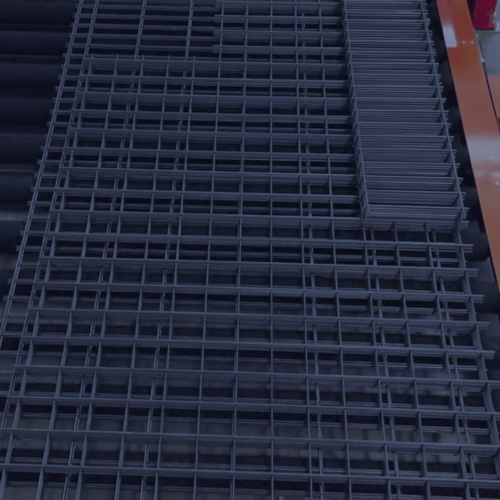
Custom welded mesh production enables reinforcement fabrication to be aligned more closely with the actual requirements of the production facility. Rather than storing, cutting and subsequently adapting standard mesh panels, the aim is to manufacture mesh directly to the required dimensions and specifications.
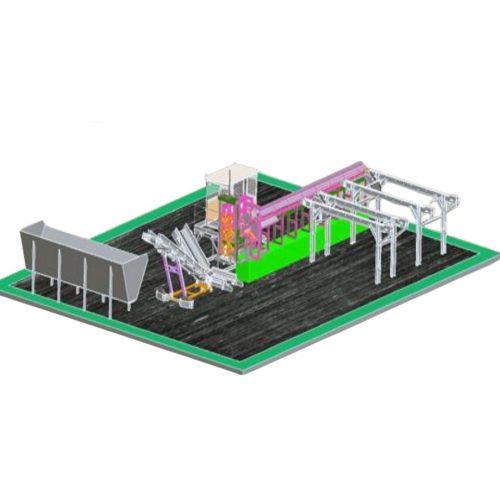
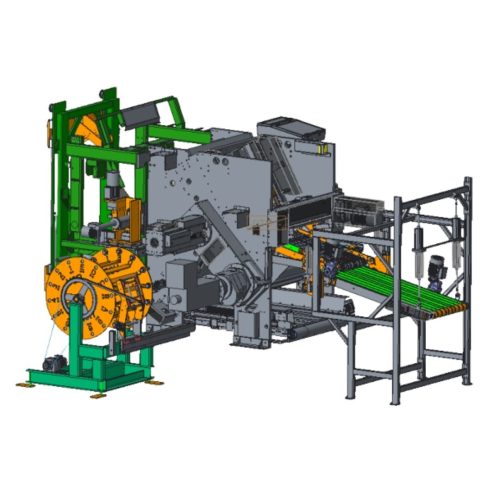
An automated welding line such as VersaLine can support this approach. It enables manufacturers to organise the production of standard or custom welded mesh according to their production requirements and the specifications of the precast concrete elements.
The main benefits include greater control over:
- panel dimensions ;
- wire diameters and positioning ;
- repeatability across production runs ;
- integration into the production schedule ;
- reduction in reworking operations ;
- availability of reinforcement when required.
For precast concrete manufacturers, this approach makes it possible to treat reinforcement fabrication as an integral part of the production process rather than as a downstream constraint requiring corrective action.
Integrating automated mesh bending
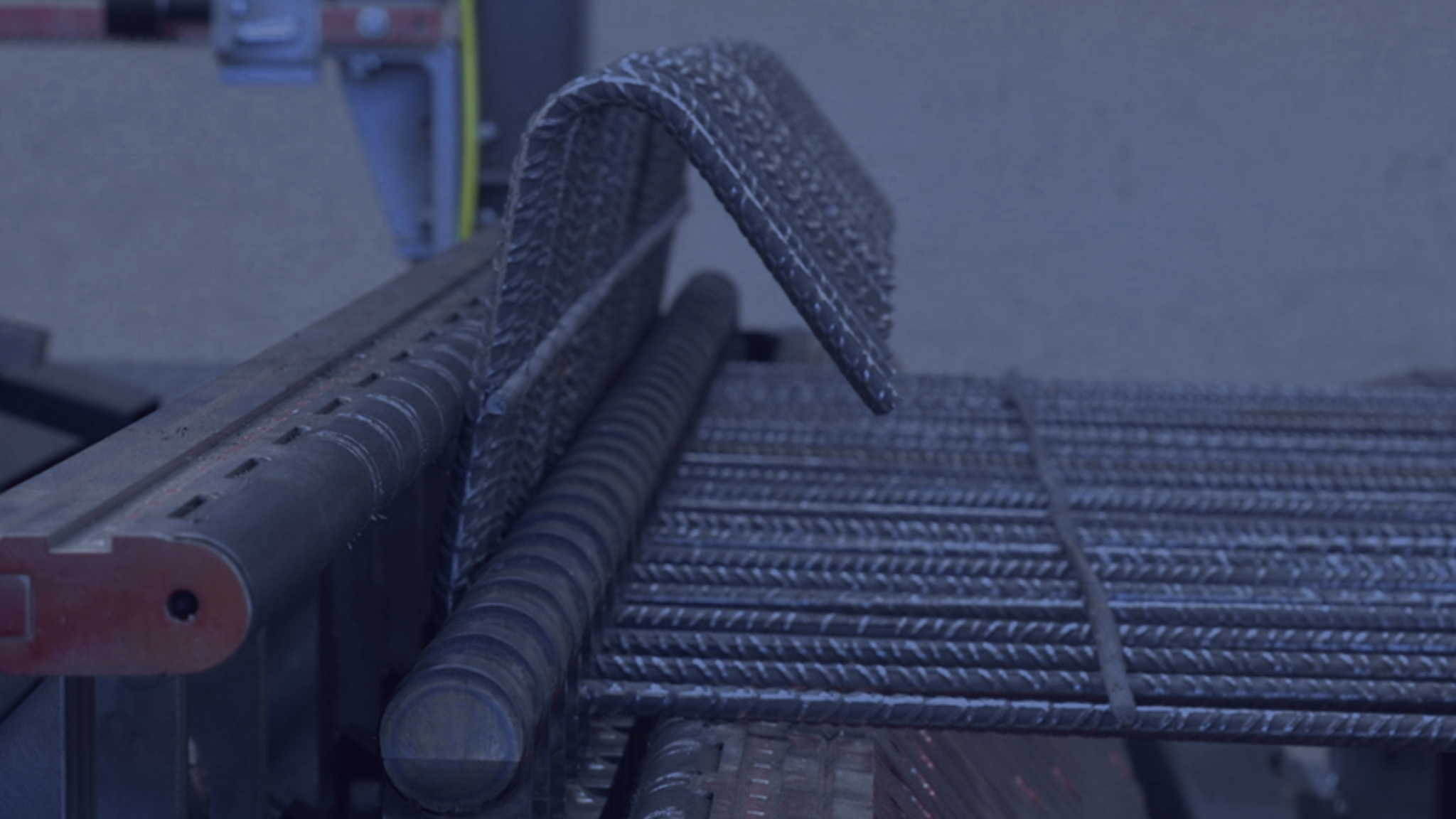
Some precast concrete elements require bent mesh or more complex reinforcement configurations. When bending is carried out manually after welding, it adds a handling stage, increases production time and may lead to dimensional deviations.
An automated bending system such as Autobend integrates mesh bending directly into the production flow. This approach is particularly beneficial for production facilities that regularly manufacture elements requiring bent reinforcement or three-dimensional configurations.
Integrating the bending stage can help to :
- reduce handling between workstations ;
- minimise manual reworking ;
- improve dimensional consistency ;
- streamline the line output process
- organise production runs more effectively ;
- improve the reliability of internal lead times.
The most suitable solution will nevertheless depend on the geometries being produced, the required production rates and the existing layout and organisation of the production facility.
What are the benefits for precast concrete manufacturers ?
Automated production of custom welded mesh can deliver benefits across several areas. The advantages are not limited to production speed; they also include improved workflow efficiency and better control of material usage.
The main benefits generally include :
- producing welded mesh tailored to project requirements ;
- minimising material waste caused by manual reworking ;
- reducing handling time ;
- improving reinforcement repeatability ;
- making internal lead times more reliable ;
- organising production changeovers more effectively ;
- reducing reliance on manual adjustments;
- improving production planning and traceability.
This approach is particularly relevant for precast concrete manufacturers handling high production volumes, variable production runs or structural elements requiring close dimensional control.
Key points to consider before investing
Before investing, manufacturers should determine whether automation addresses a genuine production requirement: welded mesh volumes, the proportion of custom production, wire diameters, bending requirements, time spent on manual reworking and the available floor space.
It is also important to define the main objective clearly: increasing production rates, reducing material waste, improving flexibility, ensuring consistent quality or strengthening traceability.
These factors help determine whether a solution such as VersaLine, Autobend or a combined configuration is suitable for the existing production organisation.
Planning an automated welded mesh production project
When assessing a project, the first step is to define the precast elements being manufactured, mesh dimensions, production volumes, wire diameters, the proportion of custom production, bending requirements and the space constraints within the production facility.
This information makes it possible to analyse the complete production flow: material supply, welding, bending, handling, intermediate storage and placement in the mould.
The objective is not to propose a standalone machine, but a complete solution aligned with the precast concrete manufacturer’s industrial organisation.
Conclusion
In precast concrete production, custom welded mesh manufacturing can become an important means of improving consistency, reducing manual reworking and maintaining better control over reinforcement flows.
Solutions such as VersaLine and Autobend support this approach when a production facility needs to manufacture custom mesh, integrate bending operations and improve production flexibility.
Are you considering automating your welded mesh production ? 3R Industries can help you assess your requirements, production volumes and facility organisation to identify a solution suited to your production needs.
FAQ
When should welded mesh production be automated ?
Automation becomes relevant when production volumes are high, mesh formats change regularly, manual reworking slows down production or reducing material waste becomes an important economic consideration.
What are the benefits of automated mesh bending?
Automated mesh bending integrates an operation that is often carried out manually into the production flow. It can reduce handling, improve shape consistency and facilitate the manufacture of more complex precast concrete elements.