Introduction
Testing a material at room temperature is not always sufficient. In many industrial sectors, a metal component, polymer, composite or assembly may behave very differently at elevated temperatures, low temperatures or after thermal exposure.
Temperature testing makes it possible to characterise these variations under conditions that more closely reflect actual service conditions. It is useful for validating a material, comparing different formulations, assessing a heat treatment or meeting a specific testing requirement.
As a French designer and manufacturer of testing machines, 3R Industries supports laboratories, R&D centres and industrial facilities in defining suitable configurations for mechanical testing under controlled temperature conditions.
Why perform temperature testing?
The mechanical properties of a material change with temperature. A polymer may lose stiffness at elevated temperatures, a metal may behave differently under high-temperature conditions, and a composite may be affected by thermal cycling or prior thermal conditioning.
Mechanical testing under controlled temperature conditions makes it possible to :
- verify material performance at elevated or low temperatures ;
- verify material performance at elevated or low temperatures ;
- characterise tensile, compression or flexural behaviour ;
- compare different formulations or heat treatments ;
- reproduce conditions closer to the actual service environment ;
- document test results as part of a quality control or qualification procedure.
The objective is therefore not simply to heat or cool a specimen. It is to control the test environment, measurement, test control and safety in order to obtain reliable and meaningful results.
When is temperature testing required ?
Temperature testing is valuable whenever a material must be validated under conditions representative of its actual service environment. Typical applications include :
- Aerospace: characterising composites, alloys and assemblies subjected to significant temperature variations.
- Automotive: testing components exposed to engine heat, low ambient temperatures or repeated thermal cycling.
- Energy and nuclear: verifying the mechanical performance of materials used in harsh or high-temperature environments.
- Metallurgy: analysing the behaviour of alloys at elevated temperatures, after heat treatment or under mechanical loading.
- Plastics and polymers: measuring stiffness loss, elongation or mechanical strength at elevated or low temperatures.
- Composites: assessing the influence of temperature on the strength, strain and performance of laminated materials.
- Research and education: comparing formulations, manufacturing processes, heat treatments or materials under controlled thermal conditions.
Which mechanical tests can be performed under controlled temperature conditions ?
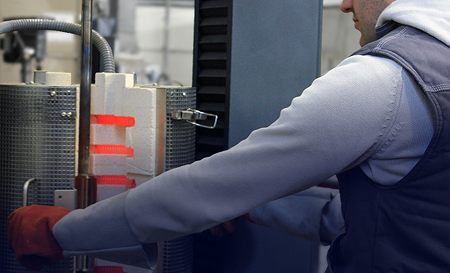
Temperature testing can be applied to a wide range of mechanical loading conditions. The most common application is tensile testing at controlled temperature, used to characterise changes in strength, elongation or modulus.
Depending on the application, a universal testing machine can also be configured to perform :
- compression testing ;
- flexural testing ;
- shear testing ;
- testing of assemblies ;
- instrumented testing with strain measurement.
The appropriate configuration depends on the material, specimen geometry, target temperature range and required level of accuracy. A suitable system must therefore combine the testing machine, thermal environment, grips, sensors and test control software.
Environmental chamber or furnace : which solution should you choose?
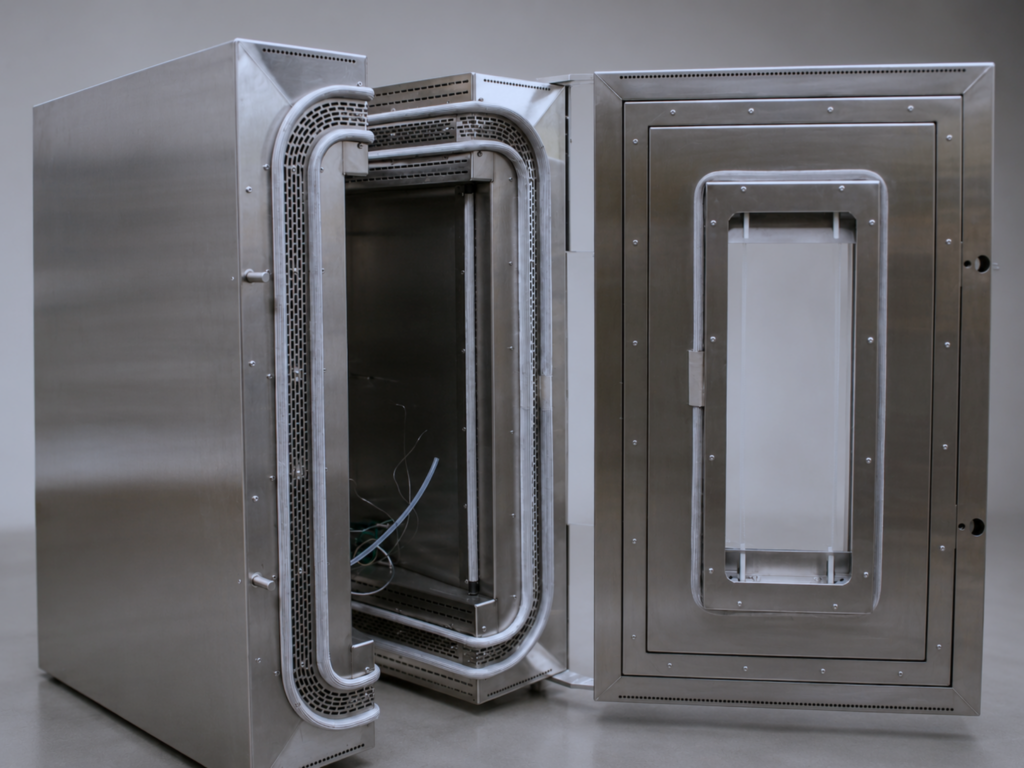
The choice between an environmental chamber and a high-temperature furnace depends primarily on the required temperature range, the material being tested and the type of test.
An environmental chamber for a testing machine is generally used for low-temperature testing, moderate elevated-temperature testing or applications requiring a controlled atmosphere around the specimen. It is suitable for polymers, composites, elastomers, assemblies and components that are sensitive to thermal conditions.
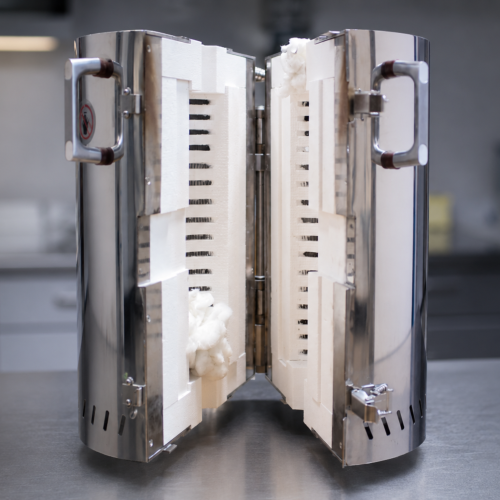
A furnace for a testing machine is generally selected for high-temperature testing, particularly on metals, alloys and materials intended for severe operating environments. It concentrates heat around the specimen’s gauge section.
| TESTING REQUIREMENT | TYPICALLY SUITABLE SOLUTION |
|---|---|
| Low-temperature testing | Environmental chamber |
| Moderate elevated-temperature testing | Environmental chamber |
| Testing of polymers or composites | Environmental chamber (depending on the test procedure) |
| High-temperature testing of metals | Furnace |
| Accurate strain measurement at elevated temperature | High-temperature extensometer |
The appropriate choice also depends on specimen accessibility, sensor routing, grip configuration and laboratory installation constraints.
Measuring strain under controlled temperature conditions
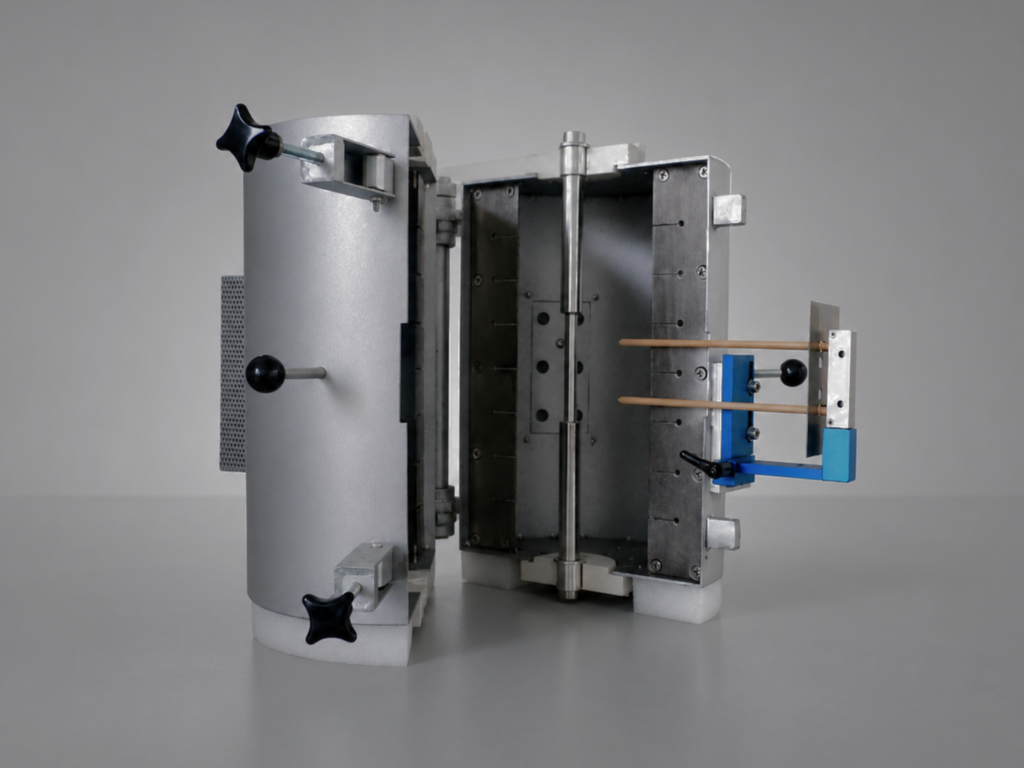
During temperature testing, strain measurement is often more challenging than at room temperature. Crosshead displacement alone is not always sufficient to accurately determine the actual strain of the specimen, particularly when measuring Young’s modulus, yield strength or precise elongation.
Depending on the application, it may be necessary to use a high-temperature extensometer, a remote extensometer, a video extensometer or another dedicated measurement solution. The selection depends on several factors :
- temperature range ;
- gauge length ;
- measurement travel ;
- required accuracy ;
- material being tested ;
- specimen accessibility inside the environmental chamber or furnace.
Strain measurement must be considered together with the thermal environment. A sensor designed for room-temperature testing may not be suitable for elevated-temperature testing, low-temperature testing or configurations with restricted access.
Planning a temperature testing project
To define a suitable testing configuration, it is useful to gather the following information from the outset :
- material being tested ;
- test type: tensile, compression, flexural or shear ;
- temperature range ;
- specimen dimensions ;
- applicable standard or test method ;
- strain measurement requirements ;
- grip or fixture requirements ;
- testing throughput ;
- required level of traceability ;
- existing testing machine or new project ;
- installation constraints.
This information makes it possible to define a coherent and appropriate testing configuration.
Conclusion
Temperature testing requires a comprehensive approach. The testing machine, thermal environment, fixtures, strain measurement system, software and safety features must all be considered together to obtain reliable and meaningful results.
Do you have a temperature testing project? 3R Industries can help you define a configuration tailored to your materials, temperature ranges and testing procedures.
FAQ
Why perform mechanical testing under controlled temperature conditions ?
Mechanical testing under controlled temperature conditions is used to characterise the behaviour of a material under conditions representative of its actual service environment, including elevated temperatures, low temperatures, controlled atmospheres or specific thermal exposure.
What is the difference between an environmental chamber and a furnace ?
An environmental chamber is used for low-temperature or moderate elevated-temperature testing in a controlled atmosphere. A furnace is designed for higher-temperature testing, particularly on metals and alloys.
Is a dedicated extensometer required for temperature testing ?
Yes, whenever strain must be measured accurately. A high-temperature extensometer must be compatible with the required temperature range, specimen geometry and target measurement accuracy.
Can an existing testing machine be adapted for temperature testing ?
In some cases, yes. Compatibility must first be verified with respect to the testing machine, test space, grips, sensors, software and safety systems.